Comparative Gospel study
Gethsemane: the agony begins
Mark 14:32–52 · Matthew 26:36–56 · Luke 22:39–53 · John 18:1–11
Opening prayer
Almighty God, whose beloved Son was obedient unto death, even death on a cross, grant us grace to watch and pray with Him in His agony. As we study the sacred accounts of His suffering, open our eyes to behold the depth of His love and the weight of the sin that He bore. Unite us with Christ in His Passion, that we may also share in His resurrection; through Jesus Christ, Your Son, our Lord. Amen.
How this session works
This session uses a layered method called the Building Approach. Rather than reading all four Gospels at once, we build understanding one layer at a time. We begin with Mark as our baseline, then add Matthew, Luke, and John in sequence, comparing each directly to what came before.
Layer 1 reads Mark in full. Layer 2 reads selected passages from Matthew where he adds something new. Layer 3 reads Luke's unique contributions. Layer 4 reads John in full, whose account is radically different throughout. The synthesis at the end holds all four portraits together.
Layer 1: The Gospel of Mark
Read aloud: Mark 14:32–52
Mark's account is raw, vivid, and unflinching. This is our baseline for comparison. As you read, listen for details that stand out.
First observations
Question 1
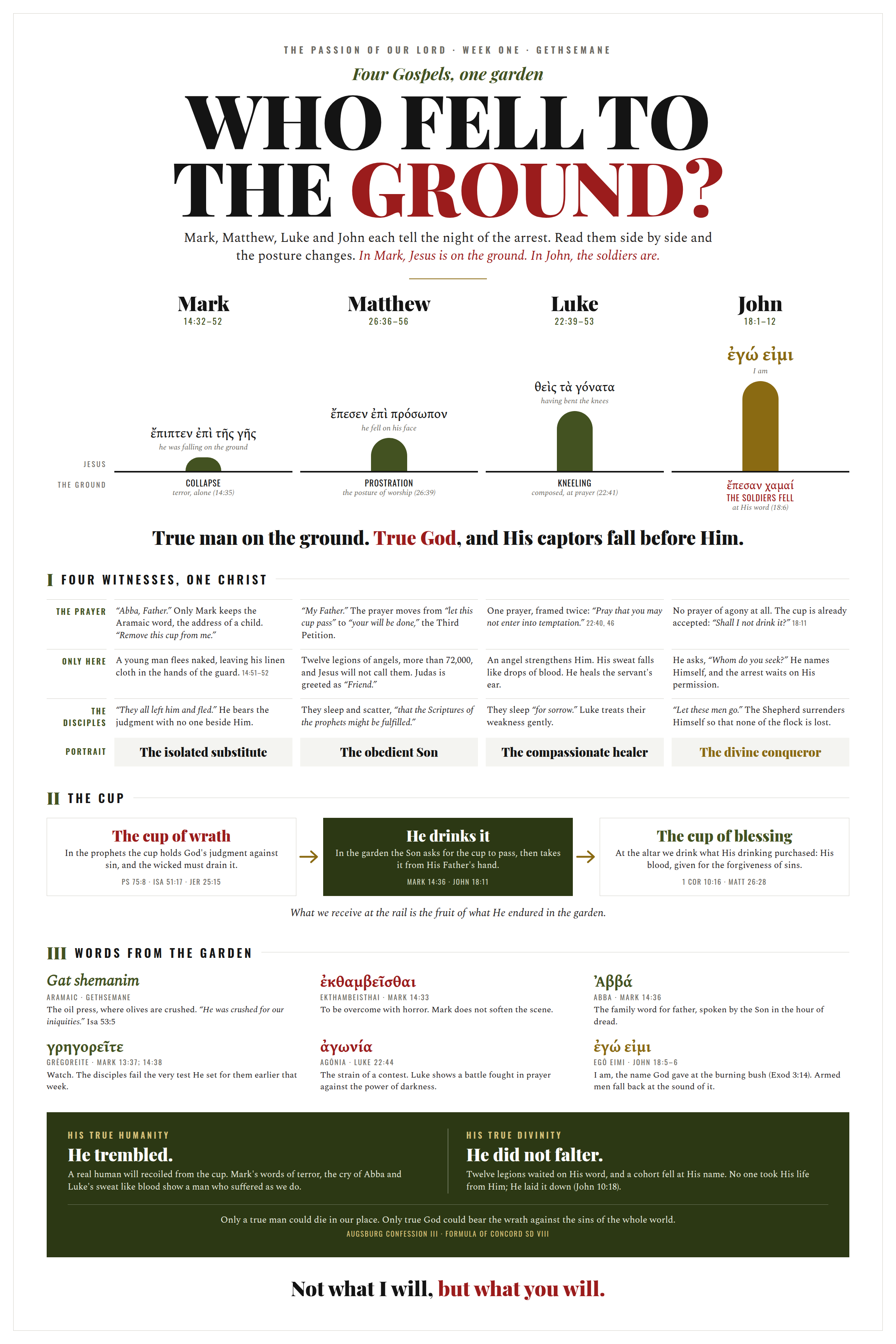
Mark calls the location "a place called Gethsemane" (14:32). The name comes from Aramaic gath shəmanim, meaning "oil press." What symbolic significance might an "oil press" have for what Jesus is about to endure?
Question 2
Mark describes Jesus' physical posture: He "fell on the ground" (14:35). How does this differ from typical prayer postures? What does this suggest about what Jesus is experiencing?
Question 3
Jesus takes Peter, James, and John further into the garden (14:33). Where else in Mark's Gospel have these same three disciples been singled out? What did they witness on that occasion, and why does that earlier event make this one more striking?
The vocabulary of terror (14:33–34)
Mark uses two Greek words to describe the internal state of Jesus that are among the strongest emotional terms in the New Testament:
ekthambeisthai (ἐκθαμβεῖσθαι) — to be overcome with amazed horror, to be greatly alarmed
adēmonein (ἀδημονεῖν) — to be in deep distress, to be beside oneself with anguish
Question 4
Jesus says, "My soul is very sorrowful, even to death" (14:34). This echoes Psalm 42:5, 11 and Psalm 43:5. How does this portrait of Jesus compare to the heroic martyr figures you may have encountered in other literature or the stories of the saints? What is Mark telling us about the kind of suffering this is?
The Abba cry and the cup (14:35–36)
Mark is the only Evangelist to preserve the Aramaic word "Abba" in the prayer of Jesus:
Question 5
What does the intimate address "Abba" reveal about the relationship between the Son and the Father, even in this moment of dread? Why might Mark have preserved the original Aramaic alongside the Greek translation?
Question 6
The "cup" is a significant Old Testament metaphor. Look up one or more of the following passages: Psalm 75:8, Isaiah 51:17, Jeremiah 25:15. What does the "cup" represent in these texts? What, then, is Jesus asking to be removed from Him?
Question 7
Jesus prays, "Not what I will, but what you will." What does this reveal about the will of Jesus? Does the Son of God possess a genuine human will that could recoil from suffering? How does His prayer resolve the tension between the two?
The failure of the disciples (14:37–42)
Question 8
Jesus returns three times to find the disciples sleeping (14:37, 40, 41). He singles out Peter by his old name, "Simon" (not "Peter"). Why is this name change significant? What had Peter, James, and John claimed they could do earlier that evening?
Question 9
In Mark 13:37, Jesus told His disciples to "Watch!" as part of His teaching about the end times. How does the command to "watch and pray" in the garden (14:38) connect to that earlier instruction? What test are the disciples failing?
The arrest and total abandonment (14:43–52)
Question 10
After the arrest, Mark records: "And they all left him and fled" (14:50). Then Mark adds a detail found in no other Gospel: a young man wearing only a linen cloth is seized, and he flees naked (14:51–52). What does this image of nakedness and flight dramatize about the situation of Jesus at this moment?
Record your portrait of Jesus in Mark. In a few words, how would you summarize Mark's portrait of Jesus in this passage? What kind of figure is He? What is His primary experience?
Layer 2: The Gospel of Matthew
Read aloud: Matthew 26:39, 42, 50, 52–54, 56b
As we listen, notice what Matthew has added or altered: the specific prayer wording, the deepened resignation, the address to Judas, and the speech about the twelve legions of angels.
26:39 And going a little farther he fell on his face and prayed, saying, "My Father, if it be possible, let this cup pass from me; nevertheless, not as I will, but as you will."
26:42 Again, for the second time, he went away and prayed, "My Father, if this cannot pass unless I drink it, your will be done."
26:50 Jesus said to him, "Friend, do what you came to do." Then they came up and laid hands on Jesus and seized him.
26:52–54 Then Jesus said to him, "Put your sword back into its place. For all who take the sword will perish by the sword. Do you think that I cannot appeal to my Father, and he will at once send me more than twelve legions of angels? How then should the Scriptures be fulfilled, that it must be so?"
Direct comparisons to Mark
Question 11
Matthew describes Jesus' posture as "fell on his face" (26:39) rather than Mark's "fell on the ground." In the Old Testament, falling on one's face is a posture associated with what kind of response to God? What does this subtle change suggest about Matthew's portrait?
Question 12
Matthew omits the Aramaic word "Abba" and uses only "My Father" (pater mou). Mark preserved both the Aramaic and the Greek. Why might Matthew have chosen to present the prayer in this way for his audience?
The progression of prayer (26:39, 42, 44)
Matthew provides the specific wording of the first two prayers. Pay close attention to the shift between them:
First prayer (26:39): "My Father, if it be possible, let this cup pass from me; nevertheless, not as I will, but as you will."
Second prayer (26:42): "My Father, if this cannot pass unless I drink it, your will be done."
Question 13
What has changed between the first and the second prayer? Where have you heard the phrase "your will be done" before? What is Matthew showing us about the movement of the heart of Jesus across these three prayers?
Material found only in Matthew
Question 14
When a disciple strikes the servant of the high priest, Jesus responds with a warning found only in Matthew: "All who take the sword will perish by the sword" (26:52). He then adds that He could appeal to His Father for "more than twelve legions of angels" (26:53). A Roman legion consisted of approximately 6,000 soldiers. What does this claim reveal about the nature of the arrest? Is Jesus being taken by force?
Question 15
Jesus explains His refusal to summon the angels: "How then should the Scriptures be fulfilled, that it must be so?" (26:54). He then summarizes: "All this has taken place that the Scriptures of the prophets might be fulfilled" (26:56). What is the driving theological concern for Matthew in this passage?
Question 16
Matthew records that Jesus addresses Judas as "Friend" (hetaire, 26:50). In Matthew's Gospel, this word appears only when addressing someone who is in the wrong (see also 20:13; 22:12). What does this form of address communicate?
Comparison: Mark vs. Matthew
| Feature | Mark | Matthew |
|---|---|---|
| Prayer address | Abba, Father | My Father |
| Physical posture | Fell on the ground | Fell on his face |
| Structure of prayer | Three repetitions of the same petition | Progressive movement toward acceptance; echoes the Lord's Prayer |
| Response to violence | No specific warning given | "All who take the sword will perish by the sword" |
| Supernatural power? | Absent | Twelve legions of angels (72,000+) |
| Driving theme | Raw suffering and total isolation | Fulfillment of the Scriptures of the prophets |
Record your portrait of Jesus in Matthew.
Layer 3: The Gospel of Luke
Read aloud: Luke 22:39–53
Luke repeats Mark's basic structure for the arrest. We focus on the verses where Luke adds something new: the Mount of Olives instead of Gethsemane, the kneeling posture, the single condensed prayer, the framing command, the angel and the bloody sweat.
Key differences from Mark and Matthew
Question 17
Luke never uses the name "Gethsemane." Instead, he says Jesus went "to the Mount of Olives, as was his custom" (22:39). Why might Luke avoid the Aramaic name? What does the phrase "as was his custom" tell us about the movements of Jesus that week, and about the opportunity it gave to Judas?
Question 18
Mark describes Jesus as falling on the ground; Matthew says He fell on His face. Luke says Jesus "knelt down" (22:41). How does this shift in posture change the tone of the scene? What kind of figure does Luke's Jesus present even in the midst of distress?
Question 19
Mark and Matthew structure the prayer in three cycles. Luke condenses the prayer into a single, intense event and frames the entire scene with a repeated command (22:40 and 22:46). What is that command? Why does Luke give it such prominence?
Material found only in Luke
Luke 22:43–44 contains a passage found in no other Gospel:
Question 20
The Father's response to the prayer of Jesus is not to remove the cup, but to send an angel to strengthen Him. What does this tell us about how God answers prayer? How does this connect to our own experience of praying through suffering?
Question 21
Luke says the disciples were "sleeping for sorrow" (22:45). Mark and Matthew offer no such explanation and instead emphasize the rebuke. Why does Luke provide this psychological detail? What does it suggest about Luke's approach to the disciples?
Question 22
During the arrest, only Luke records that Jesus healed the ear of the servant of the high priest (22:51) and said, "No more of this!" What does this action reveal about the character of Jesus, even in the moment of His arrest? How does it connect to themes in the rest of Luke's Gospel?
Question 23
Jesus declares to His captors: "This is your hour, and the power of darkness" (22:53). What does this statement suggest about the nature of the arrest? Is this merely a human event, or something more?
Comparison: Luke vs. Mark and Matthew
| Feature | Mark and Matthew | Luke |
|---|---|---|
| Location name | Gethsemane | Mount of Olives (as was His custom) |
| Posture of Jesus | Fell on the ground / fell on His face | Knelt down |
| Number of prayers | Three distinct cycles | One single, intense period |
| Divine response | Silent (until the arrest) | Angelic strengthening; sweat like blood |
| The disciples | Rebuked for failing to watch | Sleeping "for sorrow" (sympathetic) |
| During the arrest | No healing recorded | Heals the servant's ear; "No more of this!" |
| Nature of the event | Prophetic fulfillment / Betrayal | Cosmic confrontation ("power of darkness") |
Record your portrait of Jesus in Luke.
Layer 4: The Gospel of John
Read aloud: John 18:1–12
John's account is radically different from the Synoptics. As we read, notice what is completely absent and what John has added that appears in no other Gospel.
What is missing? (Compare to Layers 1–3)
Question 24
List the major elements from Mark, Matthew, and Luke that are entirely absent from John's account. Think about the prayer, the emotional state of Jesus, the disciples, and the role of Judas.
The "I AM" theophany (18:4–6)
When the soldiers say they seek Jesus of Nazareth, Jesus replies, "I am he" (Ego eimi, Ἐγώ εἰμι). Upon hearing this, the soldiers and officers drew back and fell to the ground.
Question 25
The phrase Ego eimi carries enormous weight in John's Gospel. Where does this phrase originate in the Old Testament? (Hint: Exodus 3:14.) What is Jesus revealing about Himself by using these words? What does the reaction of the soldiers confirm?
Question 26
If the soldiers fall to the ground at the sound of His voice, how is it possible that Jesus is then arrested? What does this sequence tell us about the nature of His arrest?
Jesus in command (18:4–9)
Question 27
In the Synoptic Gospels, Judas identifies Jesus with a kiss. In John, Jesus steps forward and asks, "Whom do you seek?" (18:4). He then commands the soldiers to let His disciples go (18:8). John tells us this was to fulfill the word Jesus had spoken: "Of those whom you gave me I have lost not one." How does this connect to Jesus' role as the Good Shepherd (John 10)?
The cup accepted (18:10–11)
In all three Synoptic accounts, Jesus prays for the cup to pass. In John, the cup appears only after Peter draws his sword. Jesus rebukes Peter:
Question 28
What is the significance of presenting the cup as already accepted, with no prayer of agony? What does this tell us about where John places the resolution of the Gethsemane struggle?
Comparison: Synoptics vs. John
| Feature | Synoptic Gospels | Gospel of John |
|---|---|---|
| Presentation of Jesus | The Sufferer in Agony | The Sovereign "I AM" |
| The cup | Petition to let the cup pass | Voluntary acceptance (no agony prayer) |
| Identification of Jesus | Judas identifies Jesus with a kiss | Jesus steps forward and identifies Himself |
| Reaction of the guards | Successfully arrest Jesus | Draw back and fall to the ground |
| Role of disciples | Fail to watch; eventually flee | Protected and released by Jesus' command |
| The arresters | Crowd from the chief priests | Roman cohort (speira) and Jewish officers |
Record your portrait of Jesus in John.
Theological synthesis
Now that we have built all four layers, we can step back and see the full picture. The four Gospels are not contradicting one another. They are giving us complementary portraits of the same Christ.
The fourfold portrait
Using the portraits you recorded at the end of each layer, write them together here:
Mark:
Matthew:
Luke:
John:
Core theological questions
Question 29 — The Personal Union
Christ is true God and true man in one person. Where in these four accounts do you see His true humanity most clearly? Where do you see His true divinity? Why is it necessary that both natures be present for our salvation?
Question 30 — The Great Exchange
Jesus drinks the "cup" of God's wrath so that we might drink the "cup" of His blessing. Where is this exchange most visible in the texts we have studied? How does the Sacrament of the Altar connect to the cup in Gethsemane?
Question 31 — Active Obedience
The submission of Jesus to the Father ("not my will, but yours") is part of His perfect obedience on our behalf. He fulfills the Law and the Prophets where we have failed. How do the words of Jesus in Gethsemane demonstrate this obedience? How does Matthew's emphasis on scriptural fulfillment reinforce this truth?
Liturgical connection
Question 32
The Church reads these narratives during Holy Week. The Synoptic accounts rotate on Palm Sunday (Series A: Matthew; Series B: Mark; Series C: Luke), and the Gospel of John is always read on Good Friday. Why do you think the Church assigns John's account to Good Friday specifically? What does his portrait of the sovereign "I AM" contribute to the worship of that day?
Question 33
The Gethsemane scene connects the Cup of the Lord's Supper with the Cup of Wrath. On Maundy Thursday, the congregation receives the Sacrament of the Altar while remembering that Jesus drank the cup of judgment so that we might drink the cup of blessing. How does studying the Gethsemane prayer deepen your understanding of what is received in the Sacrament?
Primary hymn connections
LSB 436 — "Go to Dark Gethsemane"
A direct companion to the Gethsemane accounts. Stanza 1 invites the singer to "Watch with Him one bitter hour," mirroring the specific command given to the disciples in Matthew 26:40 and Mark 14:37. The text transitions from the internal struggle in the Garden to the "judgment hall" in Stanza 2, tracking the movement from Luke 22:41–44 to the arrest and trial scenes in Matthew 26:57.
LSB 419 — "Savior, When in Dust to Thee"
A Lenten litany focusing on the humanity of Christ. Stanza 3 recalls the "agony and prayer at Gethsemane," referencing the specific accounts in Matthew 26:36–45, Mark 14:32–42, and Luke 22:39–46. It highlights the "dread, mysterious hour" and the "insulting tempter's power," providing a prayerful response to the spiritual warfare and the "hour" of darkness mentioned in Luke 22:53.
LSB 445 — "When You Woke That Thursday Morning"
Grounded in the Passion narratives of Matthew 26:17–46 and John 13. Stanza 3 moves directly into the Garden, emphasizing the intentionality of Christ who "woke that Thursday morning" fully aware He was to be betrayed — a theme prominent in John 18:4 where Jesus, "knowing all that would happen to him, came forward."
Closing prayer
Lord Jesus Christ, in the garden You embraced the Father's will, though it meant drinking the cup of wrath that was ours to drink. You did not shrink from bearing our sins, though their weight pressed You to the ground. You revealed Yourself as the eternal I AM, yet submitted to arrest like a common criminal. Grant us grace to behold You in Your Passion: truly human in Your suffering, truly divine in Your sovereignty, truly ours in Your redeeming love. Keep us watching and praying, that we may not fall into temptation. And when our hour comes, give us faith to trust in You who conquered death by dying. For You live and reign with the Father and the Holy Spirit, one God, now and forever. Amen.