Comparative Gospel study
The Jewish trial and Peter's denial
Mark 14:53–72 · Matthew 26:57–75 · Luke 22:54–71 · John 18:12–27
Opening prayer
O Lord, who endured false accusation and unjust condemnation for our sake, forgive us when we, like Peter, deny knowing You. Restore us by Your grace and strengthen our confession of faith; through Jesus Christ, our Lord. Amen.
How this session works
This session continues the layered Building Approach from Session One. We study how each Evangelist portrays the trial of Jesus before the Sanhedrin and the simultaneous failure of Peter. We build one layer at a time: Mark's intercalation structure, Matthew's study of oaths, Luke's morning trial and the look of the Lord, and John's hearing before Annas where Jesus puts His own judges on trial.
The synthesis at the end holds all four portraits together under one theological proclamation: the Innocent One is condemned so that the guilty one might be restored.
Layer 1: The Gospel of Mark
Read aloud: Mark 14:53–72
Mark provides the most direct and visceral account. Pay close attention to the structure: Mark arranges this passage as a "sandwich," placing the trial of Jesus inside the brackets of Peter's denial.
The intercalation structure
Mark's narrative uses what scholars call an "intercalation" or "sandwich" structure. The story of Peter's denial is split into two halves with the trial of Jesus placed between them:
A: Peter follows into the courtyard (14:53–54)
B: The Trial and Faithful Confession of Jesus (14:55–65)
A': The Interrogation and Faithless Denial of Peter (14:66–72)
Question 1
Why would Mark arrange the narrative this way? What is he forcing the reader to compare? What is the effect of reading about the faithfulness of Jesus and the failure of Peter as simultaneous events?
The trial before the Sanhedrin (14:55–65)
Question 2
Mark emphasizes twice that the testimony of the witnesses "did not agree" (14:56, 59). Why does Mark stress this point? What does the failure of the witnesses reveal about the nature of the proceedings against Jesus?
Question 3
Only Mark records the specific accusation that Jesus spoke of a temple "made with hands" (cheiropoieton) versus one "not made with hands" (acheiropoieton). What theological distinction might these terms carry? What "temple" is Jesus actually speaking about?
The direct "I Am" (14:61–62)
The high priest asks, "Are you the Christ, the Son of the Blessed?" Mark uses the euphemism "Son of the Blessed" (tou eulogētou), preserving a Jewish sensitivity about the divine name. Jesus replies with an unambiguous "I am" (Ego eimi).
Question 4
In Session One, we encountered the phrase Ego eimi in John's account of the arrest, where the soldiers fell to the ground. Here in Mark, Jesus uses the same phrase before the Sanhedrin. He then combines Psalm 110:1 and Daniel 7:13 to describe His future vindication. What is Jesus claiming about His identity by uniting these two Old Testament texts?
Prophetic irony (14:65)
After condemning Jesus, the guards blindfold Him, strike Him, and taunt Him: "Prophesy!"
Question 5
While the guards mock Jesus as a false prophet inside the palace, what is happening simultaneously in the courtyard? What specific prophecy of Jesus is being fulfilled at that very moment? What does this irony reveal about who the true Prophet is?
The denial of Peter (14:66–72)
Question 6
Mark records distinctive details in Peter's denial. In his first denial, Peter uses a double negation: "I neither know nor understand what you mean" (14:68). Mark also notes that Peter retreated to the "forecourt" (proaulion). What do these details suggest about the psychological and physical movement of Peter away from Jesus?
Question 7
Mark alone records that the rooster crowed twice (14:68, 72), fulfilling the specific wording of the prophecy of Jesus in Mark 14:30. Mark then uses the difficult verb epibalon (14:72) to describe Peter's reaction, often translated "he broke down and wept." Why might Mark preserve these precise details about the rooster and the intensity of Peter's collapse?
Record your portrait of Jesus in Mark.
Layer 2: The Gospel of Matthew
Read aloud: Matthew 26:57–75
Matthew follows Mark closely, but sharpens the contrast between the testimony of Jesus and the denial of Peter into a study of oaths. As we read, listen for how the theme of sworn speech runs through the entire passage.
Direct comparisons to Mark
Question 8
Matthew explicitly names the high priest as Caiaphas (26:57) and notes that the scribes and elders were "already gathered." He also records that "two witnesses came forward" (26:60). Why is the number "two" significant in the context of Jewish law? (Hint: Deuteronomy 19:15.)
Question 9
In Mark, the witnesses say Jesus will "destroy the temple." In Matthew, the witnesses say Jesus said, "I am able (dynamai) to destroy the temple of God" (26:61). What is the significance of the word "able"? How does this shift the charge from a threat of destruction toward a claim of messianic power?
The adjuration and the answer (26:63–64)
In a detail unique to Matthew, the high priest does not simply ask a question. He places Jesus under a formal legal oath: "I adjure you by the living God, tell us if you are the Christ, the Son of God" (26:63).
Question 10
Jesus had been silent (26:63). Why does He break His silence specifically in response to this adjuration? What does it reveal about His respect for the name of God and the lawful authority of the office of the high priest, even when the man holding the office is unjust?
Question 11
Instead of Mark's direct "I am," Jesus replies, "You have said so" (Su eipas, 26:64). This is an affirmative answer, yet it thrusts the responsibility of the confession back onto Caiaphas. What is the effect of making the high priest's own words serve as the confession of truth?
Peter's denial: a counter-narrative of oaths (26:69–75)
Matthew structures Peter's failure as a direct opposite to the testimony of Jesus. Watch the escalation:
First denial (26:70): a simple denial before them all.
Second denial (26:72): a denial with an oath (horkos).
Third denial (26:74): a denial with cursing and swearing (katathematizein).
Question 12
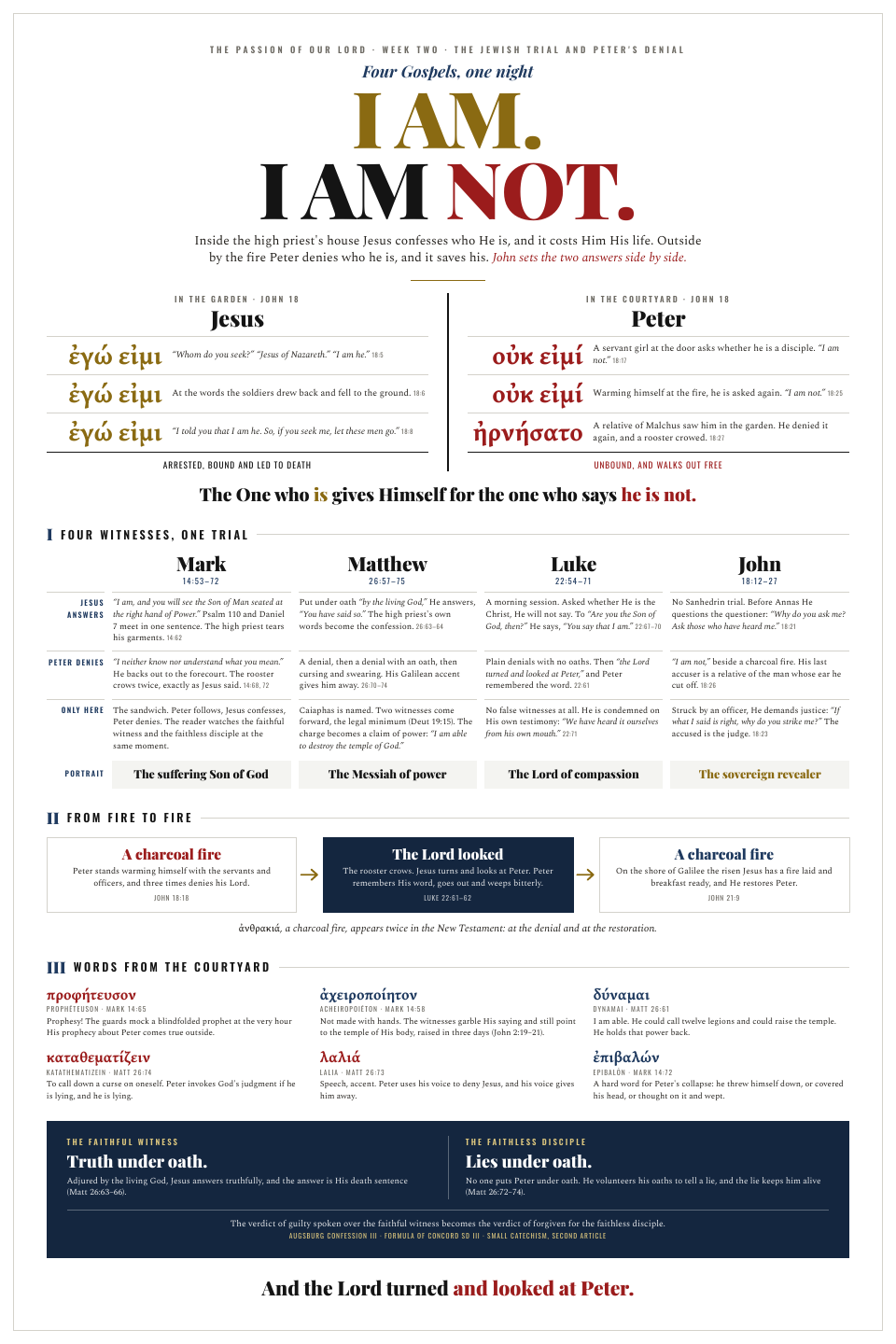
Jesus speaks the truth under oath, and it leads to His death. Peter voluntarily swears oaths to tell a lie, and it preserves his life. How does Matthew use this contrast to illuminate the difference between the Faithful Witness and the Faithless Disciple?
Question 13
Matthew notes that the bystanders recognize Peter because "your accent betrays you" (26:73). His Galilean dialect exposes him. What is the deeper irony of Peter being betrayed by his own speech, given that his speech is exactly what he is using to deny his Lord?
Comparison: Mark vs. Matthew
| Feature | Mark | Matthew |
|---|---|---|
| Jesus' reply | Direct: "I am" (Ego eimi) | "You have said so" (Su eipas) |
| The high priest | "Son of the Blessed" (euphemism) | Named: Caiaphas; formal adjuration under oath |
| Temple charge | "Made with hands" / "not made with hands" | "I am able to destroy" (claim of power) |
| Witnesses | Testimony did not agree (stressed twice) | Two witnesses came forward (Deut 19:15) |
| Peter's denial | Double negation; rooster crows twice; "broke down" | Escalating oaths; accent betrays him |
| Central contrast | Faithful confession vs. faithless denial (intercalation) | Truth under oath vs. lies under oath |
Record your portrait of Jesus in Matthew.
Layer 3: The Gospel of Luke
Read aloud: Luke 22:54–71
Luke's account is distinct in its chronological arrangement and its emphasis on the prophetic awareness of Jesus. Luke removes the "sandwich" structure found in Mark and presents the events in three separate blocks: (1) Peter's denials, (2) the mocking by the guards, (3) the formal interrogation "when day came."
Key structural differences
Question 14
Unlike Mark and Matthew, Luke places the formal trial session in the morning rather than at night. He also separates the denials of Peter from the trial, placing them before the trial rather than wrapping them around it. What is the effect of this rearrangement? How does it change the way the reader experiences each event?
The look of the Lord (22:61)
After the rooster crows, Luke records a detail found in no other Gospel:
Question 15
This is the only Gospel to record a direct visual connection between Jesus and Peter at the moment of the denial. What does this "look" accomplish? What causes Peter to remember the word of the Lord and weep bitterly? Is this look one of condemnation, compassion, or something else entirely?
Question 16
Luke records Peter's denials as direct statements without the oaths and cursing that Matthew includes. Why might Luke have chosen to present the denial in this simpler form? How does this keep the focus on the fulfillment of the word of Jesus rather than on the escalating guilt of Peter?
The mocking and prophetic irony (22:63–65)
Question 17
Luke places the beating and mocking before the trial. The guards blindfold Jesus and demand, "Prophesy! Who is it that struck you?" (22:64). This occurs immediately after the prophecy of Jesus regarding Peter has been fulfilled. What is the irony of mocking someone as a false prophet at the exact moment his prophecy has just come true?
The two-stage interrogation (22:66–71)
The council asks two questions: (1) "If you are the Christ, tell us" (22:67), and (2) "Are you then the Son of God?" (22:70). Jesus answers the second with "You say that I am."
Question 18
Jesus refuses to answer the first question directly, saying that if He told them, they would not believe. He instead shifts their focus to His future exaltation "at the right hand of the power of God." Why does Jesus decline a direct answer to the first question yet respond to the second? What distinction is He drawing between the titles "Christ" and "Son of God" in this context?
Question 19
The trial concludes not with a legal vote on a specific charge, but with the declaration: "What further testimony do we need? We have heard it ourselves from his own mouth" (22:71). Luke omits the false witnesses entirely. What is the theological significance of Jesus being condemned solely on the basis of His own words about His identity?
Comparison: Luke vs. Mark and Matthew
| Feature | Mark and Matthew | Luke |
|---|---|---|
| Timing of the trial | Night session before the Sanhedrin | Morning session: "when day came" (22:66) |
| Structure | Intercalation (sandwich: denial/trial/denial) | Three sequential blocks: denial, mocking, trial |
| False witnesses | Present; testimony does not agree | Omitted entirely; self-testimony of Jesus only |
| The look of Jesus | Absent | "The Lord turned and looked at Peter" (22:61) |
| Peter's denial | Oaths, cursing, double negation | Direct statements without oaths |
| Prophetic irony | Mocked as prophet during trial (simultaneous) | Mocked as prophet after denial fulfilled (sequential) |
| Jesus' answer | "I am" / "You have said so" | Two-stage: declines the first, affirms the second |
Record your portrait of Jesus in Luke.
Layer 4: The Gospel of John
Read aloud: John 18:12–27
John's account stands apart from the Synoptics. There is no Sanhedrin trial, no false witnesses, and no formal charge. Instead, Jesus is brought to Annas, where He puts His own judges on trial.
The hearing before Annas (18:12–14, 19–24)
Question 20
Uniquely, John records that Jesus was led first to Annas, the father-in-law of Caiaphas (18:13). Annas had been high priest previously and retained the prestige of the title. John then reminds the reader of the prophecy of Caiaphas: "that it is expedient for one man to die for the people" (18:14). Why does John insert this reminder at this moment? How does it frame the entire proceeding as the fulfillment of the plan of God for substitutionary atonement?
Jesus as the open revealer (18:19–23)
The high priest questions Jesus about His disciples and His teaching. Instead of answering as a defendant, Jesus seizes control of the interrogation.
Question 21
Jesus declares: "I have spoken openly to the world... I have said nothing in secret" (18:20). He then challenges the proceedings by demanding that witnesses be produced. In the Synoptic accounts, Jesus is largely silent before His accusers. Here, He interrogates the interrogator. What does this reversal reveal about John's portrait of Jesus? Who is actually on trial?
Question 22
When an officer strikes Jesus for His answer, Jesus does not absorb the blow in silence. He demands justice: "If what I said is wrong, bear witness about the wrong; but if what I said is right, why do you strike me?" (18:23). How does this response differ from the silent suffering of the Synoptic accounts? What is Jesus exposing about the proceedings?
Peter's denial: the "I am not" (18:15–18, 25–27)
John provides unique details: Peter gains access to the courtyard through "another disciple" known to the high priest. John places the scene around a charcoal fire (anthrakia), noting that it was cold (18:18).
Question 23
In the garden (John 18:5–8), Jesus identified Himself three times with the divine "I am he" (Ego eimi), and the soldiers fell to the ground. In the courtyard, Peter identifies himself three times with "I am not" (Ouk eimi, 18:17, 25, 27). What is the theological significance of this contrast? How do these two phrases define the difference between the Faithful Witness and the Faithless Disciple?
Question 24
In the third denial, John heightens the tension by identifying the accuser as a relative of Malchus, the man whose ear Peter cut off in the garden (18:26). He asks, "Did I not see you in the garden with him?" Why does John include this specific detail? How does it connect Peter's violence in the garden to his cowardice in the courtyard?
Comparison: Synoptics vs. John
| Feature | Synoptic Gospels | Gospel of John |
|---|---|---|
| The proceeding | Formal trial before the Sanhedrin | Hearing before Annas (no Sanhedrin trial) |
| Jesus' posture | Largely silent; answers when pressed | Seizes control; interrogates the judge |
| False witnesses | Present (Mark, Matthew); omitted (Luke) | Absent; Jesus demands witnesses be produced |
| The strike | Guards mock and strike after the verdict | Officer strikes; Jesus demands legal justification |
| Peter's denial | Oaths, accent, crowd pressure | "I am not" (three times); relative of Malchus |
| Central contrast | Faithful confession vs. faithless denial | "I AM" (Jesus) vs. "I am not" (Peter) |
Record your portrait of Jesus in John.
Theological synthesis
The four Evangelists present a unified theological proclamation: the Innocent One is condemned so that the guilty one might be restored. This is achieved through a dramatic juxtaposition of Jesus as the Faithful Witness and Peter as the Faithless Disciple.
The fourfold portrait
Mark:
Matthew:
Luke:
John:
Core theological questions
Question 25 — The Great Exchange in the trial
While Jesus is inside offering a "good confession" that leads to His death, Peter is outside offering a false denial to save his life. Jesus stands faithful as the Son of God; Peter falls as the representative of weak humanity. Where in your own life do you recognize the pattern of Peter? Where does the faithfulness of Jesus comfort you in the face of your own failures?
Question 26 — The Two Adams
Peter represents the "Old Adam" who is fearful and lying. Jesus is the "New Adam" who is faithful and speaks truth even unto death. How does the trial of Jesus demonstrate His active obedience on our behalf? How does this connect to the doctrine that His perfect faithfulness is credited to us?
Question 27 — The means of grace in repentance
Peter was restored by the word of Jesus (the fulfilled prophecy) and the look of Jesus (Luke 22:61). The Law crushed his self-confidence; the Gospel healed his soul. How do these "means of grace" — Word and the compassionate presence of the Lord — continue to function in the life of the Church today?
Question 28 — Vicarious silence and witness
The silence of Jesus before His accusers fulfills Isaiah 53 ("like a sheep before its shearers is silent"). Yet His verbal witness confirms His identity as our Priest and King. How do these two postures — silence and speech — work together in the trial to accomplish our salvation?
Liturgical connection
Question 29
The Church reads the full Passion Narrative on Palm Sunday, rotating through the Synoptic Gospels annually. The Gospel of John is always read on Good Friday. How does hearing the denial of Peter in the context of worship prepare the congregation to receive the Lord's Supper? What comfort does the restoration of Peter offer to those who approach the altar knowing their own failures?
Question 30
The hymn "What Wondrous Love Is This" (LSB 543) is connected to the denial of Peter in the liturgical tradition. The Church marvels that the Lord would bear the curse for a soul that denies Him. How does the juxtaposition of the trial and the denial deepen your understanding of the "wondrous love" proclaimed in this hymn?
Primary hymn connections
LSB 609 — "Jesus Sinners Doth Receive"
The LSB connects the repentance of Peter to stanza 2 of this hymn. It highlights that the forgiveness of Jesus restores even those who fall deeply — the pattern of Peter's collapse and restoration made available to every believer at the altar.
LSB 440 — "Jesus, I Will Ponder Now"
The suggested hymn response to Mark 14:53–72. This prayer asks for the ability to cherish the image of the suffering of Christ — to sit with the intercalation structure that Mark constructs and feel the full weight of both the faithful confession and the faithless denial.
LSB 543 — "What Wondrous Love Is This"
The LSB connects John 18:12–27 to stanza 1 of this hymn. The Church marvels that the Lord would bear the curse for a soul that denies Him three times. The charcoal fire of the courtyard becomes the context for contemplating love that is not earned and cannot be forfeited by cowardice.
Closing prayer
Lord Jesus, You endured false witness and unjust condemnation in silence. When we are tempted to deny You, look upon us with Your merciful eyes and restore us. Help us to confess You boldly before others, trusting in Your forgiveness when we fall. Amen.