Week Four
The Barabbas Exchange, Scourging, and Sentencing
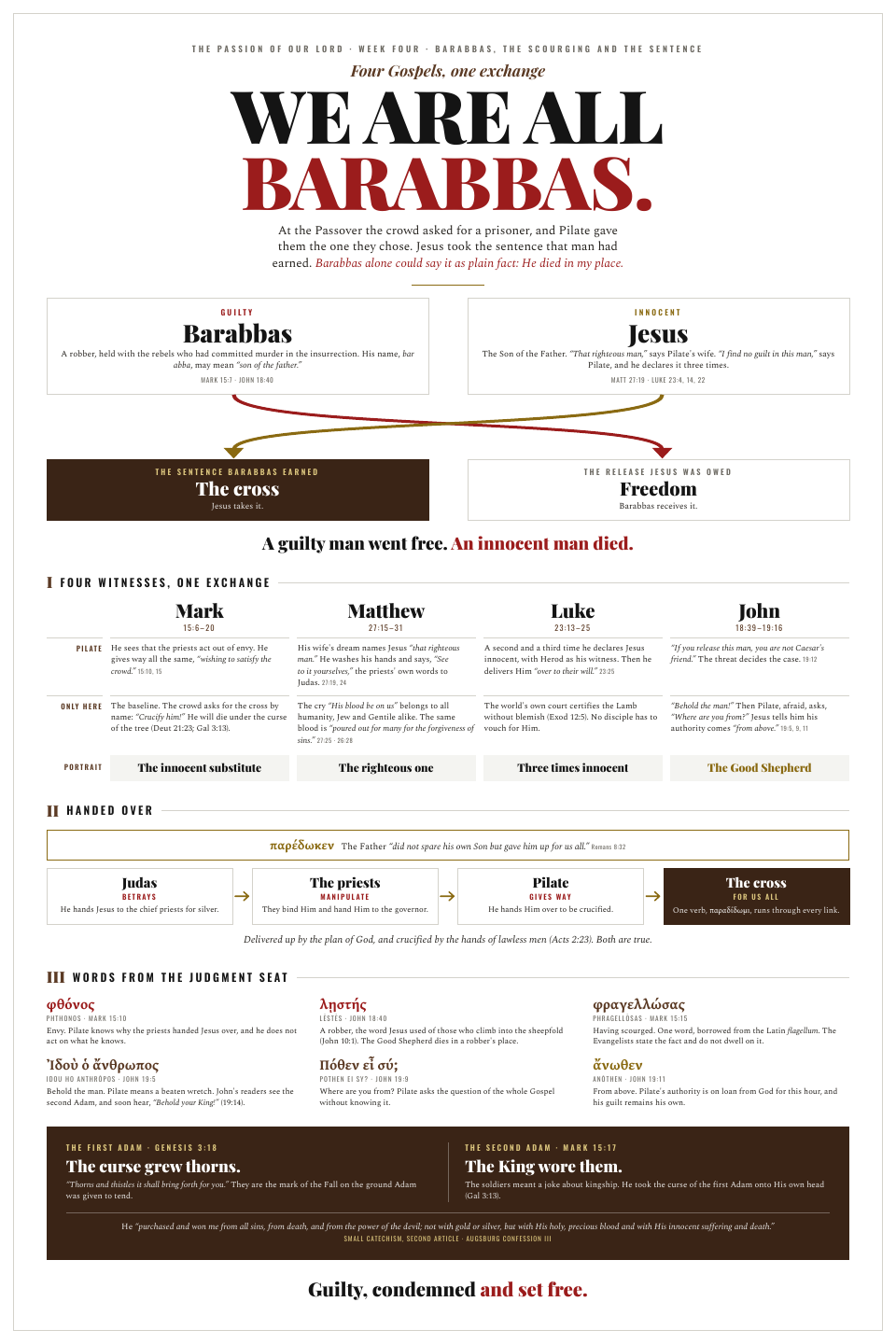
Mark 15:6–20 · Matthew 27:15–31 · Luke 23:13–25 · John 18:39–19:16a
Opening Prayer
Lord Jesus Christ, Lamb of God, You were handed over to the will of sinners and exchanged for a guilty man so that the guilty might go free. Open our eyes to see in the Barabbas exchange the pattern of our own redemption: You took our place, bore our sentence, and set us free. Grant us grateful hearts and steadfast faith; through Jesus Christ, our Lord. Amen.
How This Session Works
This session covers the most theologically dense sequence of events in the Passion narrative. A hybrid approach is used to fit the material well:
- Part One (The Barabbas Exchange) receives the full four-layer Building Approach. Each Evangelist contributes genuinely distinct material: Mark gives the baseline, Matthew adds the dream and handwashing, Luke completes the threefold innocence pattern from Week Three, and John adds the political threat that forces Pilate's hand.
- Part Two (The Scourging, Mocking, and Sentencing) uses a compressed approach. The Synoptic accounts overlap heavily (Mark and Matthew are nearly identical; Luke's mocking occurred under Herod in Week Three). We read the Synoptic material as a single comparative unit, then give John his own full treatment for the Ecce Homo ("Behold the Man!"), which is radically different from anything in the Synoptics.
This hybrid method preserves the Building Approach where the Gospels diverge and avoids redundancy where they converge.
Part One
The Barabbas Exchange
Full four-layer Building Approach — Mark 15:6–15a · Matthew 27:15–26 · Luke 23:13–25 · John 18:39–40; 19:12–16a
The Gospel of Mark
Mark 15:6–15a
The Custom and the Choice (15:6–14)
Mark introduces a custom at the feast: the governor would release one prisoner whom the crowd requested. He identifies Barabbas as a man who committed murder during an insurrection. Pilate offers the crowd "the King of the Jews," but the chief priests stir up the crowd to ask for Barabbas instead.
Greek Vocabulary — Mark 15:7, 10
- 1. Mark says Pilate perceived that the chief priests had delivered Jesus out of "envy" (phthonon). If Pilate recognizes that this is not a matter of justice but of jealousy, why does he not simply release Jesus? What does his failure to act on this knowledge reveal about the nature of political authority when it is divorced from moral courage?
- 2. The name "Barabbas" may derive from the Aramaic bar abba, which some scholars read as "son of the father." If this reading is correct, the crowd chooses a "son of the father" who is a murderer and rejects the true Son of the Father who is the giver of life. Regardless of the etymology, what is the theological significance of the substitution itself? Barabbas is guilty and goes free; Jesus is innocent and takes his place. In what sense does Barabbas represent every human being?
- 3. The crowd cries "Crucify him!" They demand not just death but a specific form of Roman execution. Mark notes that Pilate acted "wishing to satisfy the crowd." What motivates this decision — justice, fear, or something else? What does this reveal about the nature of the sentence passed on Jesus?
Record Your Portrait of Jesus in Mark: How does Mark present Jesus in the exchange with Barabbas? What is Mark's distinctive emphasis in this scene?
The Gospel of Matthew
Matthew 27:15–26
The Dream of Pilate's Wife (27:19)
While Pilate sits on the judgment seat, his wife sends a message: "Have nothing to do with that righteous man, for I have suffered much because of him today in a dream."
Greek Vocabulary — Matthew 27:19, 24
- 4. Matthew is the Gospel of divine dreams (the Magi in 2:12; Joseph in 1:20, 2:13, 2:19–20). Pilate's wife calls Jesus "righteous" (dikaios). This is the same word family Pilate will use when he washes his hands and declares himself "innocent of this man's blood" (27:24). How does the dikaios vocabulary connect the dream to the handwashing? What is the irony of Pilate claiming to be "innocent" of the blood of the one his own wife has identified as "righteous"?
The Handwashing and the Self-Curse (27:24–25)
Pilate takes water and washes his hands before the crowd: "I am innocent of this man's blood; see to it yourselves." The people answer: "His blood be on us and on our children!"
- 5. Handwashing as a declaration of innocence is a Jewish ritual (cf. Deuteronomy 21:6–7), not a Roman one. The phrase "see to it yourselves" echoes the identical words the priests used to dismiss Judas in 27:4. What does this chain of moral abdication — from priests to Judas, from Pilate to the crowd — reveal about human responsibility for the death of Jesus? Can guilt be transferred by ritual or words, or does the chain implicate everyone who participates?
- 6. The people's cry, "His blood be on us and on our children," has been tragically misused throughout history. The confessional Lutheran reading insists that this self-curse applies to all humanity, not to a single ethnic group. How does the sacramental use of Christ's blood transform this verse? Consider that the blood the crowd invokes in guilt is the same blood the Church receives in the Lord's Supper "for the forgiveness of sins" (Matthew 26:28).
Comparison — Mark vs. Matthew
| Feature | Mark's Account | Matthew's Account |
|---|---|---|
| Barabbas | A murderer and insurrectionist. | A "notorious prisoner"; possibly named "Jesus Barabbas." |
| Pilate's Wife | Not mentioned. | Sends a message calling Jesus "righteous" (dikaios). |
| Pilate's Response | Acts from political expediency. | Washes his hands; declares himself "innocent." |
| The People | Cry "Crucify him!" | Cry "His blood be on us and on our children." |
Record Your Portrait of Jesus in Matthew: How do the dream, the handwashing, and the self-curse shape Matthew's portrait of Jesus as the Innocent One? What moral landscape does Matthew paint around him?
The Gospel of Luke
Luke 23:13–25
The Threefold Declaration of Innocence (23:14–15, 22)
- 7. Pilate declares Jesus innocent a second time (23:14–15), this time invoking Herod as a second witness: "Neither did Herod, for he sent him back to us." Then a third time (23:22): "Why? What evil has he done? I have found in him no guilt deserving death." Three formal declarations by the Roman governor. Why does Luke build this threefold pattern? What is the theological function of establishing the innocence of Jesus through the testimony of a pagan judge who will nevertheless sentence him to death?
Barabbas and the Sentencing (23:18–25)
Luke provides the most detailed description of Barabbas's crimes: he was thrown into prison "for an insurrection started in the city and for murder." Luke summarizes the sentencing with a single, precise phrase: Pilate "delivered Jesus over to their will."
- 8. Luke does not say Pilate delivered Jesus "to be crucified" or "to the soldiers." He says Pilate delivered Jesus "to their will" (23:25). Compare this to Mark's language ("wishing to satisfy the crowd") and to John's language ("handed him over to them to be crucified"). What does Luke's choice of words reveal about where he places the moral responsibility for the death of Jesus?
Comparison — Luke vs. Mark and Matthew
| Feature | Mark / Matthew | Luke's Account |
|---|---|---|
| Innocence Verdict | Implied or stated once. | Three formal declarations (23:4, 14, 22). |
| Barabbas Description | Murderer; insurrectionist. | Thrown in prison for insurrection in the city and for murder. |
| Pilate's Wife | Present in Matthew; absent in Mark. | Not mentioned. |
| Sentencing Language | Delivered to be crucified / to satisfy the crowd. | Delivered Jesus "to their will." |
Record Your Portrait of Jesus in Luke: How does the completed threefold innocence pattern shape Luke's portrait of Jesus? What does Luke want his reader to understand about the one being sentenced?
The Gospel of John
John 18:39–40; 19:12–16a
The Barabbas Exchange and the Political Threat (18:39–40; 19:12–16a)
Greek Vocabulary — John 18:40; 19:12
- 9. John identifies Barabbas as a "robber" or "brigand" (lēstēs). This is the same word Jesus used in John 10:1 for the thieves who do not enter the sheepfold by the door. How does this vocabulary connect the Barabbas exchange to the Good Shepherd discourse? What does it mean that the Good Shepherd is exchanged for a wolf?
- 10. The Jewish leaders tell Pilate: "If you release this man, you are not Caesar's friend" (19:12). "Friend of Caesar" (amicus Caesaris) was a Roman political title. This is a career threat, not a legal argument. How does this detail change your understanding of why Pilate sentences Jesus? Is it a judicial decision or a political surrender? What does it reveal about the power of worldly pressure to override the knowledge of truth?
- 11. After the sentencing, John writes: "He handed him over to them to be crucified" (19:16a). The verb is paradidōmi ("handed over"), the same word used for Judas handing Jesus to the priests (Week Two) and the priests handing him to Pilate (Week Three). The chain is now complete. How does this single verb, traced across three sessions, hold together the human guilt and the divine purpose in the death of Jesus?
Comparison — The Synoptic Gospels vs. John (Barabbas Exchange)
| Feature | The Synoptic Gospels | John's Account |
|---|---|---|
| Barabbas | Murderer / insurrectionist. | A lēstēs (brigand/robber); echoes John 10. |
| Pilate's Motivation | Envy, crowd pressure, political expediency. | Explicit threat: "You are not Caesar's friend." |
| Scourging Placement | After the sentencing. | Before the sentencing; interwoven with Ecce Homo. |
| The paradidōmi | Implied or briefly stated. | Explicit; completes the chain from Judas to Pilate. |
Record Your Portrait of Jesus in John: How does John's framing of the Barabbas exchange — the Good Shepherd, the political threat, the completed chain — shape his portrait of Jesus? Who is in control of these events?
Part Two
The Scourging, Mocking, and Crowning
Compressed Synoptic unit, then full treatment of the Ecce Homo in John — Mark 15:15b–20 · Matthew 27:27–31 · John 19:1–11
Mark and Matthew: The Scourging and Crowning
Mark 15:15b–20 · Matthew 27:27–31
The Scourging and the Crowning
The soldiers scourge Jesus (phragellōsas), dress him in a purple robe (Mark) or scarlet cloak (Matthew), plait a crown of thorns, and hail him as "King of the Jews" in parody of "Ave, Caesar!" They strike his head, spit on him, and kneel in mock homage.
Greek Vocabulary — Mark 15:15b–17
- 12. The Evangelists describe the scourging in a single word. They do not elaborate on the physical suffering. Why do you think the Gospel writers exercise this restraint? What is the relationship between the theological significance of the suffering and its graphic description? What do we lose or gain by focusing on the meaning rather than the details?
- 13. The crown of thorns (stephanon ex akanthōn) is a parody of the laurel or radiate crown worn by rulers. Yet thorns are also the sign of the curse upon creation: "Thorns and thistles it shall bring forth for you" (Genesis 3:18). The soldiers mock Jesus as king; the text reveals that the King is wearing the curse of the Fall. How does the crown of thorns connect the Passion to the story of creation and the Fall? What does it mean for the Second Adam to wear the curse of the First Adam?
Synoptic Differences — The Scourging and Crowning
| Feature | Mark | Matthew | Luke |
|---|---|---|---|
| Scourging | phragellōsas (single word) | phragellōsas (identical) | Not described here (cf. Herod mocking, 23:11) |
| Robe | Purple (porphyran) | Scarlet (kokkinēn chlamyda) | Splendid (esthēta lampran) under Herod |
| Crown of Thorns | Present | Present | Not mentioned |
| Battalion | Whole cohort assembled | Whole cohort assembled | Not specified |
The Gospel of John: Behold the Man
John 19:1–11
Greek Vocabulary — John 19:5, 8–9
- 14. Pilate brings Jesus out wearing the crown of thorns and the purple robe and says: "Behold the man!" (Idou ho anthrōpos!, 19:5). On the surface, Pilate means this dismissively: "Look at this wretch; surely this is punishment enough." Yet John's readers hear more. How might the phrase "Behold the man" carry a deeper christological meaning? Who is "the Man" in the context of John's Gospel?
- 15. After the Ecce Homo, the leaders reveal their deeper accusation: "He has made himself the Son of God" (19:7). Pilate becomes "even more afraid" (mallon ephobēthē, 19:8). The comparative "more" implies that Pilate was already afraid. He asks Jesus: "Where are you from?" (Pothen ei sy?, 19:9). In John's theology, the question of origin is the essential question. What is Pilate really asking? Does he know he is asking the most important question in the Gospel?
- 16. Jesus tells Pilate: "You would have no authority over me at all unless it had been given you from above" (19:11). This statement affirms the sovereignty of God over the entire trial. How does this statement change the way we understand the Passion narrative? Is the trial a miscarriage of justice that escaped God's control, or is it the means by which God accomplishes his saving purpose?
Theological Synthesis
The Barabbas exchange and the events that follow constitute the most theologically concentrated sequence in the Passion narrative. The visible substitution of a guilty man for an innocent one enacts the doctrine of vicarious atonement in narrative form.
The Fourfold Portrait
Using the portraits you recorded at the end of each layer, write them together here:
Mark
Matthew
Luke
John
Core Theological Questions
- 17. The Great Exchange: Barabbas is the only person in history who can say with literal, physical truth, "Jesus died in my place." A guilty murderer is set free; an innocent Righteous One takes his place. The Lutheran doctrine of the "joyful exchange" (fröhliche Wechsel) teaches that Christ takes our sin and we receive his righteousness. How does the Barabbas exchange make this abstract doctrine visible and concrete? In what sense is every baptized Christian Barabbas?
- 18. The Crown of the Curse: The crown of thorns connects the Passion to the Fall. Thorns entered the world through sin (Genesis 3:18). The Second Adam wears the consequence of the First Adam's disobedience. How does this connection between the crown and Genesis 3 deepen your understanding of what Christ accomplishes on the cross? What is being reversed or restored?
- 19. The Completed Chain: The verb paradidōmi ("handed over") has been traced across three sessions — Judas to the priests, the priests to Pilate, Pilate to the cross. Yet Romans 8:32 says the Father "did not spare his own Son but gave him up (paredōken) for us all." How do you hold together the human guilt and the divine purpose? Does the divine purpose excuse the human agents, or does it deepen the mystery?
- 20. The Ecce Homo: Pilate says, "Behold the man!" The soldiers dress Jesus in royal robes and crown him with thorns. Every act of mockery is an unwitting proclamation of truth: He is the King; He does bear the curse. The world ridicules what it cannot comprehend, and in ridiculing it confesses the truth. Where else in the Passion narrative have you seen this pattern of mockery as unwitting confession?
Liturgical Connection
- 21. Luther's Small Catechism explains the Second Article: "Jesus Christ has redeemed me, a lost and condemned person, purchased and won me from all sins, from death, and from the power of the devil; not with gold or silver, but with His holy, precious blood and with His innocent suffering and death." How is the Barabbas exchange the narrative enactment of this confession? What does "purchased and won" look like in the scene we have studied today?
- 22. The hymn "O Sacred Head, Now Wounded" (LSB 450) addresses the crowned head of Christ directly: "Now scornfully surrounded / With thorns, Thine only crown." How does this hymn invite the congregation to stand in the scene and address Christ personally? What is the difference between reading about the crown of thorns and singing to the one who wears it?
Lectionary Usage
These texts are central to the observance of Holy Week in the Lutheran tradition.
- Palm Sunday, Series A: Matthew 27:11–54 (or 26:1–27:66) is the Gospel, including the release of Barabbas, the mocking, and Simon of Cyrene.
- Palm Sunday, Series B: Mark 15:1–39 (or 14:1–15:47) is the Gospel, including the Barabbas narrative, the soldier's mockery, and Simon of Cyrene.
- Palm Sunday, Series C: Luke 23:1–49 (or 22:1–23:56) is the Gospel, including the trial before Pilate and Herod, the release of Barabbas, and the unique address to the Daughters of Jerusalem.
- Good Friday (all three series): John 19:1–17 is read every year as part of the Passion of Our Lord according to St. John (John 18:1–19:42), covering the scourging, "Behold the Man," and the sentencing at Gabbatha.
- One-Year Lectionary, Palm Sunday (Palmarum): Matthew 27 (often including vv. 15–32).
Hymnody
O Sacred Head, Now Wounded (LSB 450)
Addresses the crowned head of Christ directly: "Now scornfully surrounded / With thorns, Thine only crown." The hymn invites the congregation into the scene of the Ecce Homo, transforming the spectacle of mockery into an act of personal address and adoration.
My Song Is Love Unknown (LSB 430)
Stanza 5 — "They rise and needs will have / My dear Lord made away; / A murderer they save, / The Prince of Life they slay" — is explicitly linked to Luke 23:18–25, reflecting on the Great Exchange of Barabbas for Jesus.
O Dearest Jesus, What Law Hast Thou Broken (LSB 439)
Stanza 3 ("Whence come these sorrows... It is my sins... This I do merit") is associated with Mark 15:16–20, emphasizing the penal substitutionary atonement where Jesus suffers the wrath the sinner deserves. Stanza 4 ("The Shepherd dies for sheep that loved to wander") is connected to the condemnation scene, highlighting the reversal where the Master pays the debt of the servants.
Ride On, Ride On in Majesty (LSB 441)
Stanza 3 ("The angel armies of the sky / Look down with sad and wond'ring eyes / To see the approaching sacrifice") captures the somber reality of the road to the cross, anticipating the events that follow the sentencing.
The Great Exchange in the Liturgy
The reading of Luke 23:18–25 in the liturgy emphasizes the irony that "Barabbas" — son of the father — is released while the true Son of the Father is condemned. This is treated as a picture of the atonement: the guilty go free because the Innocent One is condemned. Every baptized Christian stands in Barabbas's place.
Mockery as Ironic Enthronement
The Roman soldiers' mockery in Mark 15:16–20, Matthew 27:27–31, and John 19:1–5 — "Hail, King of the Jews!" — is treated liturgically not merely as abuse but as the paradoxical revelation of Christ's true kingship. He reigns from the tree, and the soldiers unwittingly speak the truth. The crown of thorns is the crown of the curse reversed; the purple robe anticipates the royal glory of the resurrection.
Closing Prayer
Lord Jesus Christ, You were exchanged for a murderer so that murderers might be made righteous. You wore the crown of the curse so that we might wear the crown of life. You stood before the judgment seat so that we might stand before the throne of grace. We are all Barabbas: guilty, condemned, and set free by Your innocent suffering and death. Receive our thanks, and keep us in the faith until the day we see You face to face. Amen.