Week Three
The Roman Trial: The Interrogation
Mark 15:1–5 · Matthew 27:1–2, 11–14 · Luke 23:1–12 · John 18:28–38
Opening Prayer
Lord Jesus Christ, King of Glory, You stood before a pagan governor and remained silent under false accusation. Grant us the courage to witness to the truth of Your kingdom in a world that often asks, "What is truth?" Strengthen our faith to see that Your humble submission to earthly authority was the path to our heavenly liberation; through Jesus Christ, our Lord. Amen.
How This Session Works
This session continues the layered Building Approach, moving from the religious condemnation of the Sanhedrin (Weeks One and Two) to the political interrogation before the Roman governor, Pontius Pilate. We build one layer at a time:
- Layer 1: Mark — Read Mark's account and identify the morning transfer, the silence of Jesus, and the astonishment of Pilate.
- Layer 2: Matthew — Compare to Mark, noting the tragic interlude of Judas and the intensified silence.
- Layer 3: Luke — Compare to both Mark and Matthew, identifying the political charges and the unique hearing before Herod Antipas.
- Layer 4: John — Discover the profound dialogue on kingship and truth inside the Praetorium.
Work through each layer, recording your observations as you go. The portrait boxes at the end of each layer will prepare you for the theological synthesis.
The Gospel of Mark
Mark 15:1–5
The Handover and the Question (15:1–2)
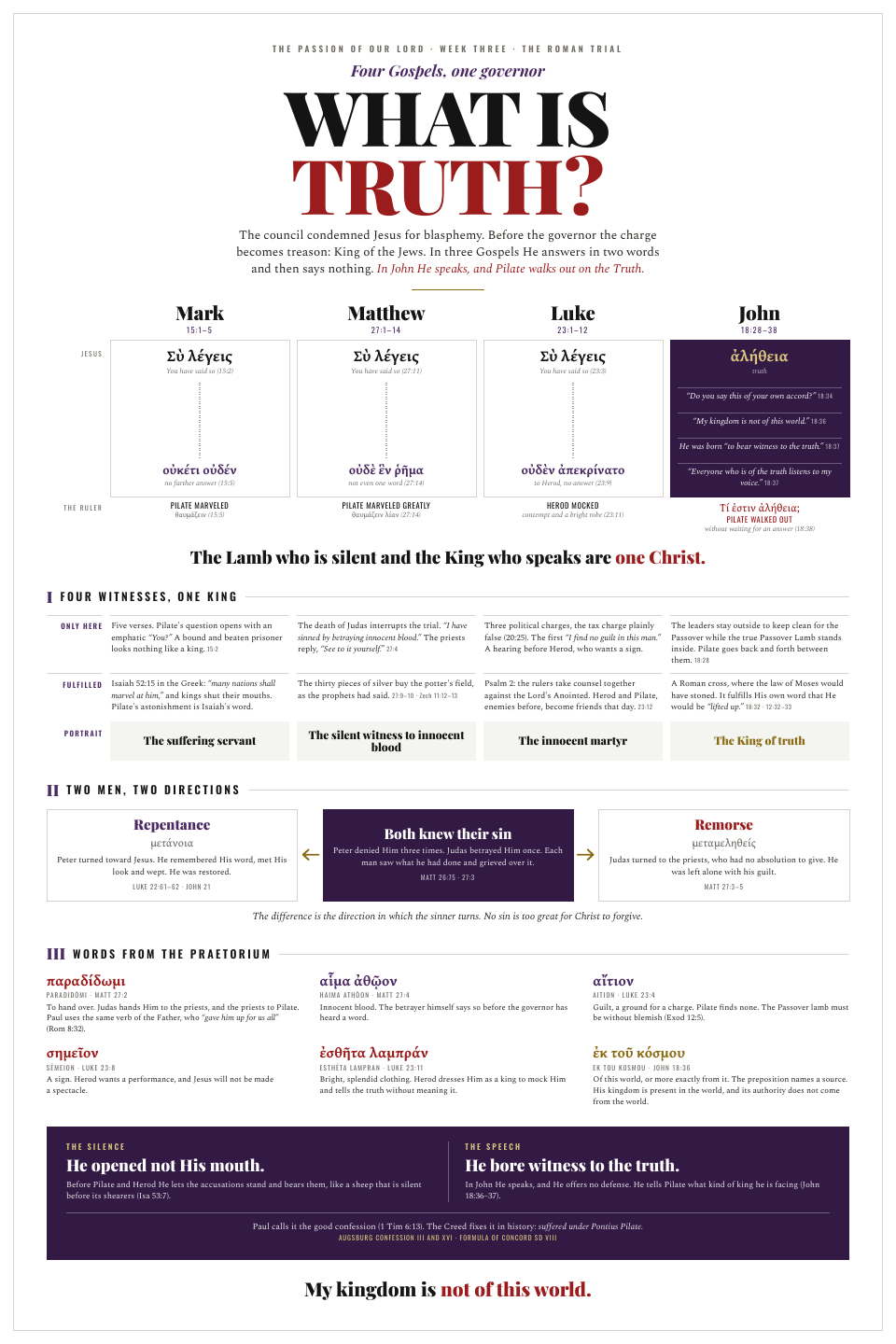
Mark notes that "as soon as it was morning," the entire council formed a plan, bound Jesus, and delivered Him to Pilate. Pilate asks a single question: "Are you the King of the Jews?"
- 1. The Jewish leaders have just condemned Jesus for blasphemy, claiming to be the Son of God. Now they bring Him to Pilate. Why would they need to change the charge from a religious accusation ("Son of God") to a political accusation ("King of the Jews")? What does this translation of the charge reveal about the limitations of the Sanhedrin's authority?
- 2. In Mark's Greek, the pronoun "You" (Sy) is placed emphatically at the beginning of Pilate's question: "You are the King of the Jews?" This implies incredulity or surprise. What might provoke this reaction in Pilate? What would a Roman governor expect a "king" to look like, and how does the appearance of Jesus contradict that expectation?
The Silence and the Marvel (15:3–5)
The chief priests "kept on accusing" Jesus (imperfect tense: repeated, ongoing accusation). Jesus offers no defense. Mark uses a strong double negative to emphasize that the silence is absolute.
Greek Vocabulary — Mark 15:3–5
- 3. In a Roman court, silence typically signaled an admission of guilt. Pilate's reaction is not just surprise but "astonishment" (thaumazein). Scholars note that this word echoes the Septuagint of Isaiah 52:15: "thus many nations shall marvel at him" and kings shall shut their mouths. How does this Old Testament connection transform the silence of Jesus from a legal strategy into an act of prophetic fulfillment?
Record Your Portrait of Jesus in Mark: In a sentence or two, capture how Mark presents Jesus in this passage. What is Mark's distinctive emphasis?
The Gospel of Matthew
Matthew 27:1–2, 11–14
The Death of Judas (27:3–10)
Uniquely in Matthew, the narrative pauses between the handover (27:1–2) and the trial itself (27:11–14) to describe the end of Judas.
Greek Vocabulary — Matthew 27:3–10
- 4. Matthew says Judas "felt remorse" (metamelētheis, 27:3). The Greek New Testament uses a different word for true repentance (metanoia). In Week Two, we saw Peter weep bitterly and later be restored by the look and word of the Lord. Judas also recognizes his sin, yet he goes to the priests rather than to Jesus. What is the difference between remorse and repentance? What determines whether a sinner's recognition of guilt leads to restoration or to despair?
- 5. Judas confesses to the priests: "I have sinned by betraying innocent blood" (haima athōōn, 27:4). The priests respond: "What is that to us? See to it yourself." What does this callous response reveal about the priests' indifference to justice? How does the theme of "innocent blood" connect to the trial before Pilate that follows?
Jesus Before Pilate (27:11–14)
The focus shifts from the guilt of Judas to the identity of Jesus as He "stood" (estatē) before the governor. Matthew intensifies the silence of Jesus: He did not answer "not even to one word" (pros oude hen rhēma). Pilate "marveled greatly" (ethaumazen lian).
- 6. Compare the silence in Mark and Matthew. Mark uses a double negative (ouketi ouden: "no longer anything"). Matthew intensifies it: "not even to one word" (pros oude hen rhēma). Mark says Pilate "marveled"; Matthew says he "marveled greatly." Why does Matthew intensify these details? What effect does the heightened silence have in the context of the Judas interlude that precedes it?
- 7. Matthew uses the verb paradidōmi ("handed over") throughout the Passion narrative. Judas "hands over" Jesus to the priests; the priests "hand over" Jesus to Pilate; and eventually Pilate will "hand over" Jesus to be crucified. What does this chain of custody reveal about who is responsible for the death of Jesus? Is it one group, or does the chain implicate everyone?
Comparison — Mark vs. Matthew
| Feature | Mark's Account | Matthew's Account |
|---|---|---|
| Narrative Flow | Continuous; moves directly from Sanhedrin to Pilate. | Interrupted; inserts the death of Judas between handover and trial. |
| Jesus' Silence | Absolute: ouketi ouden (no longer anything). | Intensified: "not even to one word" (pros oude hen rhēma). |
| Pilate's Reaction | Pilate "marveled" (thaumazein). | Pilate "marveled greatly" (ethaumazen lian). |
| Theological Motif | The Suffering Servant fulfilling Isaiah 52. | The "Innocent Blood" of the Judas interlude. |
Record Your Portrait of Jesus in Matthew: How does the Judas interlude shape Matthew's presentation of Jesus? What does Matthew want you to see about the one standing before Pilate?
The Gospel of Luke
Luke 23:1–12
The Political Charges (23:1–5)
The Jewish leadership brings three specific charges before Pilate: (1) Subversion — "perverting our nation"; (2) Tax Evasion — "forbidding us to give tribute to Caesar"; (3) Sedition — "claiming he is Christ a King." Pilate focuses only on the third charge.
Greek Vocabulary — Luke 23:4, 9
- 8. The tax evasion charge is demonstrably false: in Luke 20:25, Jesus explicitly said, "Render to Caesar the things that are Caesar's." Why would the leaders include a charge they know to be false? What does this tell us about the nature of the proceedings? How does Luke's inclusion of this detail serve his theme of Jesus' innocence?
- 9. After hearing Jesus' response, Pilate declares: "I find no guilt (aition) in this man" (23:4). This is the first of a pattern of formal declarations of innocence in Luke, who will record two more such declarations later in the narrative. Why does Luke emphasize the formal, legal innocence of Jesus? What theological purpose does it serve for the one condemned to be formally declared "not guilty" by the very judge who sentences Him?
The Hearing Before Herod Antipas (23:6–12)
Only Luke records this episode. Hearing that Jesus is a Galilean, Pilate sends Him to Herod Antipas, who happens to be in Jerusalem for the feast. Herod is "very glad" to see Jesus, hoping to witness a miracle.
- 10. Herod wants to see a "sign" (sēmeion) from Jesus. Jesus "answered him nothing." Compare this silence to the silence before Pilate in Mark and Matthew. Pilate marvels at the silence; Herod mocks it. What does the different reaction of each ruler reveal about the difference between genuine astonishment at the Suffering Servant and the contempt of one who merely wants entertainment?
- 11. Herod and his soldiers mock Jesus by clothing Him in "splendid clothing" (esthēta lampran: bright, shining garments) — a mockery of His kingship. Later, the Roman soldiers will conduct a separate mockery with a purple robe and a crown of thorns. What is the significance of Jesus being mocked as king by two separate jurisdictions? How does this double mockery serve Luke's theme of widened responsibility?
- 12. Luke notes that Herod and Pilate "became friends with each other that very day, for before this they had been at enmity" (23:12). The early church interpreted this as a fulfillment of Psalm 2:1–2: "The kings of the earth set themselves, and the rulers take counsel together, against the Lord and against his Anointed." How does the reconciliation of these two enemies over the condemnation of Jesus fulfill this psalm?
Comparison — Luke vs. Mark and Matthew
| Feature | Mark / Matthew | Luke's Account |
|---|---|---|
| Nature of Charges | Primarily the title "King of the Jews." | Threefold political charges: subversion, tax evasion, sedition. |
| The Herod Trial | Not present; Jesus remains with Pilate. | Jesus is sent to Herod Antipas (Galilean jurisdiction). |
| Judicial Verdict | No formal verdict at this stage. | Formal declaration: "I find no guilt" (aition). |
| The Mockery | Occurs later under Roman soldiers. | Occurs now under Herod and his soldiers. |
Record Your Portrait of Jesus in Luke: How does Luke's distinctive material — the political charges, the Herod hearing, the repeated declarations of innocence — shape his portrait of Jesus? What is Luke's theological emphasis?
The Gospel of John
John 18:28–38
The Setting and the Irony (18:28–32)
The Jewish leaders bring Jesus to the Praetorium but refuse to enter it themselves, lest they be "defiled" and unable to eat the Passover.
Greek Vocabulary — John 18:32, 37
- 13. The leaders are scrupulous about ceremonial purity: they will not enter a Gentile building lest they become ritually unclean. Yet they are simultaneously manipulating the legal system to execute an innocent man. What is the irony John is exposing? How does this contrast between ritual purity and moral corruption illuminate the difference between outward religion and true righteousness?
- 14. John notes that the leaders want a Roman execution rather than a Jewish one. He explains that this fulfills the prophecy of Jesus that He would be "lifted up" (hypsōthēnai) on a cross (cf. John 3:14; 12:32–33). Crucifixion is a Roman method; stoning is a Jewish one. Why is the method of execution theologically significant in John? What does it mean for Jesus to be "lifted up"?
The Dialogue: Kingship and Truth (18:33–38)
Pilate enters the Praetorium and asks Jesus directly: "Are you the King of the Jews?" Instead of the brief "You say so" of the Synoptics, Jesus engages Pilate in a sustained conversation about the nature of His kingdom.
- 15. Jesus responds to Pilate's question with a question of His own: "Do you say this of your own accord, or did others say it to you about me?" (18:34). In the Synoptics, Jesus is largely silent; here, He interrogates the interrogator. What does this reversal reveal about John's portrait of Jesus? Who is really in control of this trial?
- 16. Jesus declares: "My kingdom is not of this world. If my kingdom were of this world, my servants would have been fighting" (18:36). What does "not of this world" mean? Does it mean His kingdom has no relationship to this world, or does it mean His kingdom does not derive its authority from this world? What is the difference?
- 17. Jesus says: "For this purpose I was born and for this purpose I have come into the world: to bear witness to the truth. Everyone who is of the truth listens to my voice" (18:37). Pilate responds: "What is truth?" (18:38). Is Pilate's question sincere, cynical, or something else? Does he wait for an answer? What does Pilate's question reveal about the position of every human being who stands before the claims of Jesus?
- 18. After this dialogue, Pilate goes back outside and declares: "I find no guilt in him" (18:38). This is a formal judicial verdict of innocence. Yet Pilate does not release Jesus. What does this reveal about Pilate? What does it mean when someone recognizes the truth but lacks the courage to act on it?
Comparison — The Synoptic Gospels vs. John
| Feature | The Synoptic Gospels | John's Account |
|---|---|---|
| Trial Location | Mostly public or outside the Praetorium. | Shifts between inside (Jesus) and outside (Jewish leaders). |
| Nature of Trial | Focus on Jesus' silence and brief affirmations. | Extended dialogue on kingship and truth. |
| Timing of Passover | Last Supper presented as the Passover meal. | Focus on the leaders preparing to eat the Passover. |
| Verdict | Implied or general declaration of innocence. | Explicit judicial declaration: "I find no guilt in him." |
Record Your Portrait of Jesus in John: How does John's Jesus differ from the largely silent figure in the Synoptics? What does the extended dialogue on truth and kingship add to the fourfold portrait?
Theological Synthesis
The four Evangelists present the Roman trial as the cosmic intersection of human history and divine purpose. The King of Kings stands before a worldly judge, formally rejected by the world's powers and simultaneously revealed as the true King and Innocent Sufferer.
The Fourfold Portrait
Using the portraits you recorded at the end of each layer, write them together here:
Mark
Matthew
Luke
John
Core Theological Questions
- 19. The Clash of Kingdoms: In all four Gospels, Pilate asks the identical question: "Are you the King of the Jews?" Jesus affirms the title but redefines it. In John, He declares that His kingdom is "not of this world." How does the Roman trial force a confrontation between the political definition of kingship — power, territory, armies — and the eschatological definition: truth, sacrifice, the Word?
- 20. The Silence of the Lamb: In Mark and Matthew, Jesus is almost entirely silent before Pilate, fulfilling Isaiah 53:7 ("like a sheep before its shearers is silent"). Yet in John, Jesus speaks at length about truth and kingship. How do you reconcile these two portraits? Is the silence in the Synoptics and the speech in John contradictory, or do they complement each other?
- 21. Substitutionary Innocence: Pilate and Herod both declare Jesus innocent. Jesus is the only person in the room with no guilt. Yet He accepts the sentence of the guilty. How do the formal legal verdicts of "no guilt" serve to establish Jesus as the unblemished Lamb of God who takes away the sin of the world? Why is it theologically important that His innocence is established by pagan rulers rather than by His own disciples?
- 22. The "Handing Over" (paradidōmi): Judas hands Jesus to the priests. The priests hand Jesus to Pilate. Pilate will hand Jesus over to be crucified. This chain implicates disciple, Jew, and Gentile. Yet Romans 8:32 says God the Father "did not spare his own Son but gave him up (paredōken) for us all." How do you hold together the human guilt and the divine purpose in the death of Jesus?
Liturgical Connection
- 23. The Apostles' Creed names only two historical figures: Mary and Pontius Pilate. The phrase "suffered under Pontius Pilate" anchors the death of Jesus in a specific time and place, under a specific governor. Why does the Church insist on naming Pilate in the Creed? What would be lost if the Creed said only "suffered and was crucified" without naming the governor?
- 24. In 1 Timothy 6:13, Paul speaks of "Christ Jesus, who in his testimony before Pontius Pilate made the good confession." The Church models its baptismal confession on this "good confession." How does the trial of Jesus before Pilate serve as the pattern for the Christian witness in a world that asks, "What is truth?"
Lectionary Usage
These narratives — Mark 15:1–5; Matthew 27:1–2, 11–14; Luke 23:1–12; John 18:28–38 — hold a central place in the Lutheran liturgical tradition.
- Good Friday (Chief Service): The Passion according to St. John (John 18–19) is the traditional Gospel reading in both the Three-Year and One-Year Lectionaries, including the interrogation on truth and kingship in John 18:28–38.
- Palm Sunday, Series A: Matthew 26:1–27:66, including the Roman trial in 27:1–2, 11–14.
- Palm Sunday, Series B: Mark 14:1–15:47, including the trial in 15:1–5.
- Palm Sunday, Series C: Luke 22:1–23:56, including both the trial before Pilate and the hearing before Herod in 23:1–12.
- One-Year Lectionary: The traditional Gospel for Palmarum (Palm Sunday) is Matthew's Passion account.
The Good Confession (1 Timothy 6:13)
The interrogation of Jesus before Pilate serves as the liturgical and catechetical model for the Christian confession of faith. Paul charges Timothy in the presence of "Christ Jesus, who in his testimony before Pontius Pilate made the good confession." This specific moment — where Jesus affirms His kingship and bears witness to the truth — is the archetype for the Christian baptismal confession and witness before a hostile world.
The Apostles' Creed
The Roman trial is the only event during Jesus' ministry explicitly named in the Creed. "Suffered under Pontius Pilate" anchors the Gospel in history. The verdict of Pilate (recorded in Luke 23:24), handing Jesus over to the will of the crowd, is the act the Church continues to confess. This historicity is not incidental: it is the theological foundation that distinguishes the Gospel from myth.
The Prayer of the Church (Acts 4)
The specific Lukan detail of the trial before Herod and Pilate (Luke 23:12) became the basis for the early church's prayer in Acts 4:24–28. The church interpreted the alliance between Herod and Pilate against Jesus as the fulfillment of Psalm 2:1–2 — and simultaneously as the occasion for bold proclamation, not silence.
Hymnody
O Dearest Jesus (LSB 439)
The scene of the trial in Mark 15:1–5, where Jesus is accused and condemned before Pilate, is linked to stanzas of this hymn meditating on the "mighty King" whose glory cannot be dimmed by the world's judgment. The hymn moves through the Passion with penitential reflection on the worshipper's own guilt.
A Mighty Fortress Is Our God
In the Series C propers (Luke's year), this hymn is sometimes associated with the "stronger man" — Jesus — overcoming the "strong man," dividing the spoils (Isaiah 53:12): a victory inaugurated by the trials and passion, and completed in the resurrection.
Theological Significance in the Liturgy
The silence of Jesus before Pilate and Herod (Mark 15:5; Matthew 27:14) is read liturgically as the fulfillment of Isaiah 53:7 — not passivity, but active submission to the Father's will to be the sacrifice for sin. The threefold verdict of innocence in Luke (23:4, 14, 22), together with Herod's finding no guilt (23:15), underlines that Jesus dies as the Innocent One, the Righteous Martyr. And the chain of paradidōmi — from Judas to the priests to Pilate — teaches that both Jews and Gentiles conspired to kill Jesus, signifying that all people are responsible for His sentence to death, even as this human evil served the definite plan of God for salvation (Acts 2:23).
Closing Prayer
Lord Jesus, You stood before Pilate to set us free from the judgment of the Law. We thank You that Your kingdom is not of this world, for our world is passing away. Keep us firm in the Truth of Your Word, that we may always listen to Your voice and remain faithful citizens of Your eternal kingdom. Amen.